.jpg)
Showing posts with label Creature Feature. Show all posts
Showing posts with label Creature Feature. Show all posts
Tuesday, June 11, 2013
Chick Crossing
Friday, November 23, 2012
Fighting Corals
Corals exemplify a common characteristic among animals -- they fight when confronted by "foreign" tissue. Corals are composed of individual yet connected zooids basically constructed much like anemones. Corals of different species will grow very close to one another in competition for space. As they come into contact. the bordering zooids of each species will attack one another. One of the two colonies may overcome the other or it may result in a standoff where neither encroaches any further. Their relative aggressiveness was determined by experiment in the laboratory but has not proved to be predictable in the field.
--David K. Bulloch, "The American Littoral Society Handbook for the Marine Naturalist"
Published 1991
--David K. Bulloch, "The American Littoral Society Handbook for the Marine Naturalist"
Published 1991
Friday, July 27, 2012
Thursday, March 8, 2012
Craig Tucker's Snow Birds

We call all our winter visitors to Florida, "SNOW BIRDS".
That includes white pelicans and other seasonal residents.


Photos by W. Craig Tucker
Sunday, February 26, 2012
Amphipods

Wednesday, February 22, 2012

Tuesday, February 21, 2012

Monday, February 20, 2012
Sunday, February 19, 2012
Florida Scrub Jay

Bud Doyle, illustrious Littoral Society outing leader, is the animal on the bottom.
Bud seems to have friended a Florida scrub jay
near the Inland Waterway south of Venice, FL..
The scrub jay may be the only bird which lives only in Florida.
Both birds are inquisitive, intelligent and surprisingly tame.
near the Inland Waterway south of Venice, FL..
The scrub jay may be the only bird which lives only in Florida.
Both birds are inquisitive, intelligent and surprisingly tame.
(The photo was stolen from Bud's Facebook.)
Friday, February 17, 2012

Tuesday, February 14, 2012
Green Striped Hermit Crab

This hermit crab's body is about 1-3 inches long.
Both pincers are more or less equal in size and held so that the 'fingers'
open horizontally in front of the animal. Often green, the walking legs are striped
along their length
Tuesday, January 24, 2012
Beaded sea cucumber.

Photo by Dave Bulloch
This is a long, wormlike sea cucumber, so extensible that exact measurements are difficult. Its skin is sticky because spicules extend from it. A ring of obvious tentacles surround the mouth area (E. lappa). The color is light gray to light brown and can be covered with patches of white.
Size: up to 10 inches, but it can extend to over 20 inches.
It hides under old coral heads during the day, often active at night.
Size: up to 10 inches, but it can extend to over 20 inches.
It hides under old coral heads during the day, often active at night.
Saturday, January 21, 2012
Can you find an animal in these photos?

PLANT: Green fleece, with spongy, dirty-green fingers, is a green algae,
It's attached at a single base to the sea bottom.

ANIMAL: Dead-man's fingers have spongy, finger-think "branches".
They are commonly beached

PLANT: Sargassum with it's tooth-edged leaves.
Normally, one can see tiny balls which are air-filled bladders.
Thursday, January 19, 2012

Monday, January 9, 2012
Cold Weather

Ibis and other birds flock to inland canals and lagoons. These ibis are in The Meadows neighborhood.
Thursday, December 22, 2011
Mottled Ducks

"Mottled Ducks feed by dabbling in shallow water, and grazing on land. They mainly eat plants, but also some mollusks and aquatic insects. The ducks are fairly common within their restricted range; they are resident all-year round and do not migrate. The breeding habitat is coastal marshes. The nest is built on the ground amongst vegetation, such as bull-rush and marsh grass." -- Wikepedia

Mottled Ducks Dipping (Tails Up)
Saturday, December 17, 2011
Bud Doyle's Beach Beat:: Scallops and River Otters
On that recent blow two weeks ago, I found hundreds of bay scallop shells on North Jetty Beach. Normally, I am able to find a number of calico scallop shells and a few bay scallops. However, on this occasion, there were only a few calicos and, as I mentioned, humdreds of bay scallop shells. I have been unable to find any answers to the above.
One more interesting note, as we were hiking the coastal forest behind Caspersen Beach we came upon a river otter swimming along in the Intracoastal Waterway. It turns out that they have been coming on to the beach from Red Lake to feed on ghost crabs. So the otters are enjoying crabs for breakfast at Caspersen Beach while I am eating cheerios on Albee Rd. in Nokomis - what's wrong with this picture??
Sunday, December 11, 2011
Hooded Mergansers

The "snow birds" are here in Sarasota for the Winter. They come down from swamps and wooded ponds of the northern half of the United States and southern Canada. Mergansers are occasionally seen on Sarasota Bay. The visitors pictured were cruising in The Meadows Community pond. Check out the Celery Fields for a possible sighting.

The single bird above is a male. He is seen with 2 females in the top photo.
Saturday, November 26, 2011
Sandpiper at Casperson Beach

It's not easy to tell the sandpipers apart. Above is either a semipalmated sandpiper or a western sandpiper. Black bills and feet, dark mottled back, and streaked breast, both are about the same size. The books say that some "cherp" and some "cheep". (My parakeet "cheeps".)
Monday, November 21, 2011
Roseate Spoonbill and White Ibis at Myakka River State Park

As you might expect, the spoonbill and white ibis are closely related.
To help confuse things, the immature white ibis is brown and
the immature roseate spoonbill is white.
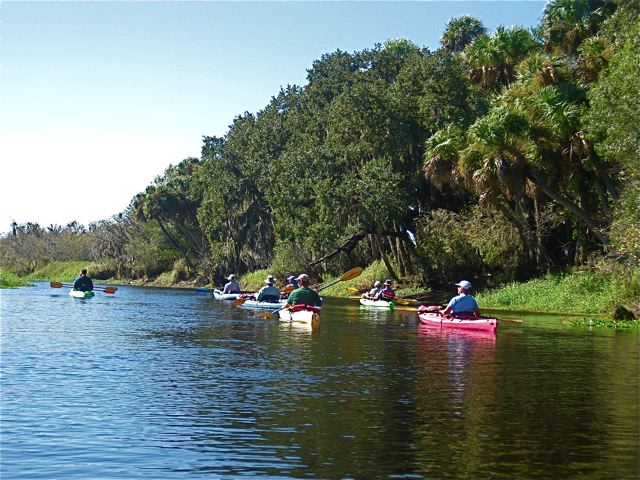
...and some other water creatures (below) enjoying a pleasant cruise.
To help confuse things, the immature white ibis is brown and
the immature roseate spoonbill is white.
...and some other water creatures (below) enjoying a pleasant cruise.
Photos by Peg Conklin
Subscribe to:
Comments (Atom)